

In Agora Education Research’s recent blog on the International Computer and Information Literacy Study (ICILS), I wrote about the study’s role in measuring digital literacy among 8th graders internationally. The study conducted by the International Association for the Evaluation of Educational Achievement (IEA) has continuously worked to incorporate test items that are relevant to the rapidly changing digital landscape. It is doing so again for ICILS 2028.
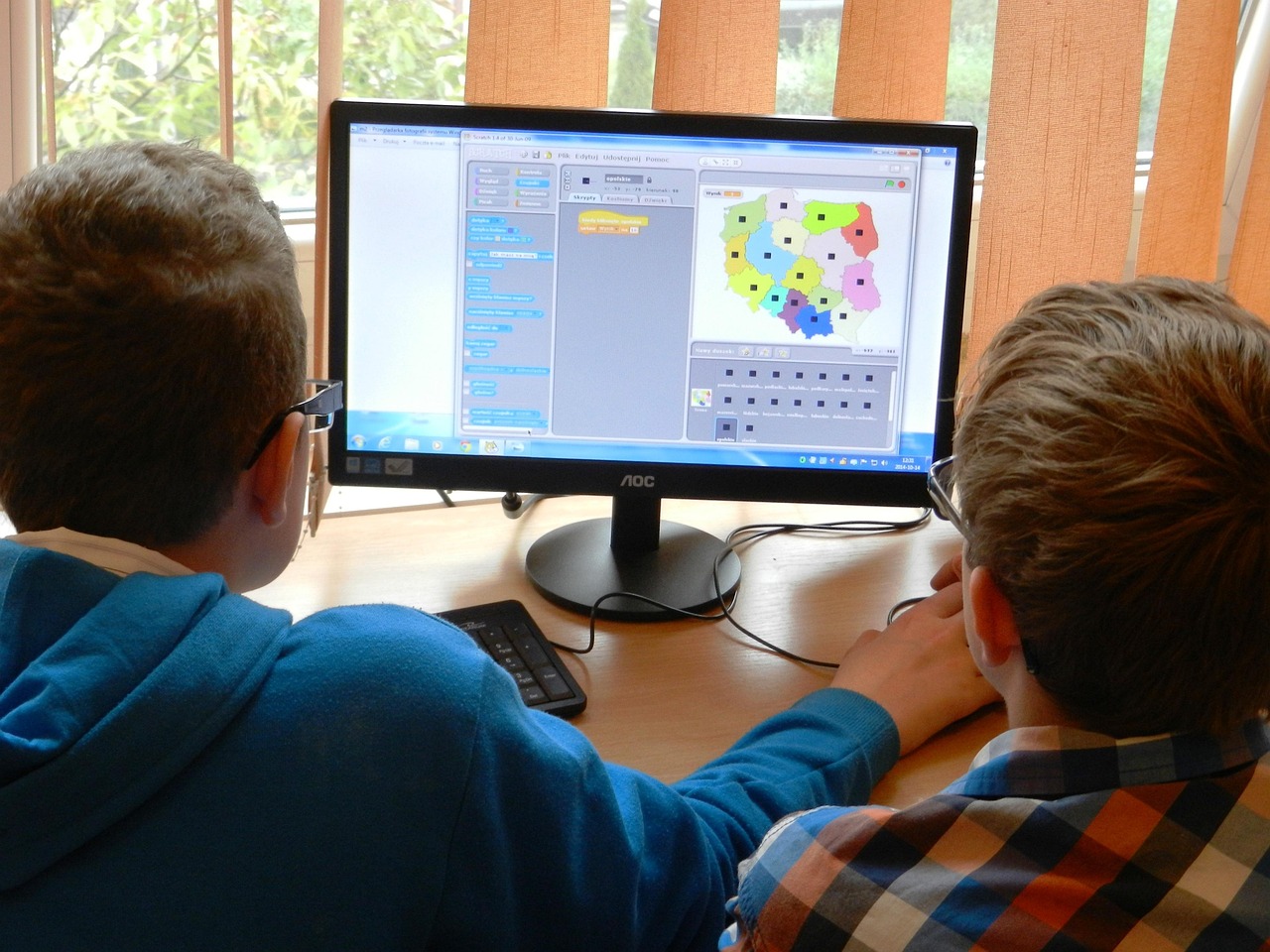
Integration of AI test and survey questions in the 2028 ICILS
This post will elaborate on the integration of Artificial Intelligence (AI) test items and survey questions in the 2028 ICILS. Shortly after the public debut of ChatGPT, a generative AI technology1, IEA augmented the ICILS 2023 data collection to gather data from school leaders on the use of AI in school, and now IEA is gearing up to measure the AI literacy of students as well as computer and information literacy and computational thinking.
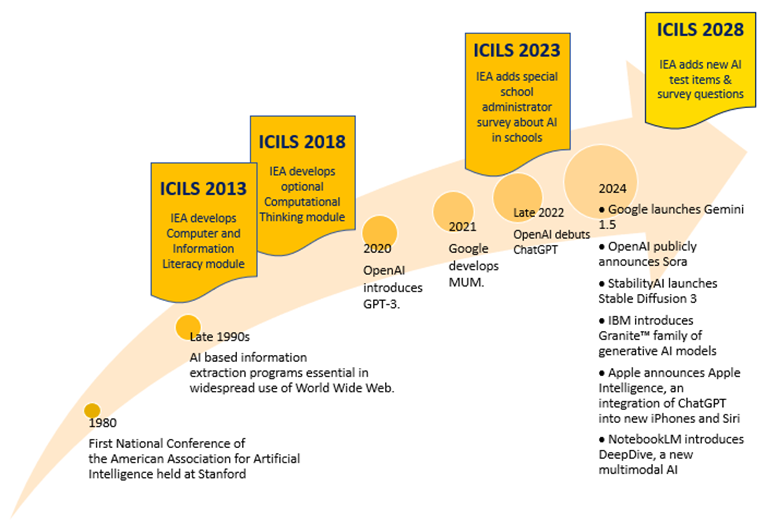
International Computer and Information Literacy Study Cycles and the Modern Artificial Intelligence Timeline 2, 3
The existing collection of Computer and Information Literacy (CIL) and Computational Thinking (CT)4 test items are being reviewed right now and new items, including AI-related items, are being developed for ICILS 2028. According to the IEA ICILS team, ICILS 2028 will integrate AI into the CIL and CT test components. Their validity and utility will be measured during a trial data collection in 2027. The final selection of items will then be incorporated into the assessment software application and used in the main data collection. Generally, ICILS test items are not released to the public so that they may be reused in future assessments; however, retired items are likely to be released in the 2028 international report to help the public understand what the ICILS assessment is all about.
Where can researchers and the public learn more about the ICILS 2028 AI measurement goals?
The forthcoming ICILS 2028 assessment framework will explain the measurement goals for the study. Built on earlier frameworks, it will describe in detail the constructs5 and contextual elements that guide ICILS instrument development. IEA aims to publish the framework by the end of 2027.
“The ICILS 2028 Assessment Framework will integrate AI into the CIL and CT constructs and the contextual framework that underpin ICILS instrument development. The use of AI tools, including critical evaluation of their use and products, will contribute to the new CIL and CT modules and the context questionnaires will include content related to the implementation of AI in policy, resourcing, planning, and teaching and learning in schools.”6
We get a preview of how AI literacy will be incorporated into the CIL and CT modules from the IEA ICILS flyer on AI literacy (PDF, 0.67mb). Broadly, ICILS will measure the following CIL and CT AI-related competencies:
Table 1. Computer and Information Literacy (CIL)
| Role | How Competency Measured |
| Digital Info Consumers | Formulate and refine prompts to generate information relevant to specific research interests |
| Evaluate AI-generated outputs with respect to: – Accuracy – Bias – Relevance | |
| Digital Info Producers | Select appropriate AI agents to complete information generation tasks |
| Formulate and refine multimodal prompts to generate content for digital information products: – Text – Images – Multimedia | |
| Digital Citizens | Demonstrate knowledge and awareness of AI technologies, their capabilities, and limitations |
| Understand and assess the personal, societal, and ethical dimensions of AI use. |
Table 2. Computational Thinking (CT)
| Role | How Competency Measured |
| Conceptualizers……….. | Analyze, select, and evaluate data and information provided to and by AI systems. |
| Operationalizers………. | Apply AI technologies to accomplish tasks, model problems, and facilitate computational work processes. |
| Systems Thinkers…….. | Understand how AI processes input, generates output, and interacts with users in applications. |
The tables above were adapted from the IEA ICILS flyer on AI literacy.

Photo by Alena Darmel
Additional survey questions about AI
In addition to asking questions about the use of and attitudes towards digital tools (i.e., desktops, laptops, tablets, or smartphones) at home and at school, ICILS 2028 will ask students and teachers about the use and availability of AI and AI tools, and their attitudes toward AI. They will also ask school administrators (e.g., principals) about policies, plans and guidelines for AI use in the school, and ask each country’s national research team about standards for teachers and students regarding the use, availability, and inclusion of AI in system-level curricula, among other questions.7 Responses to these questions should prove very useful to national and global policy makers, education systems, and private technology industries.
Findings on AI usage from ICILS 2023
There is much contextual information that may be gleaned from the special 2023 survey on generative AI usage given to school administrators whose schools participated in ICILS 2023.8 ICILS conducted this survey to pave the way for the integration of AI-related content in 2028. Twelve countries9 from around the globe were able to participate in the AI survey. The U.S. did not due to the predetermined timeline for completing the data collection. Please refer to the ICILS 2023 international report for the complete results.
By 2023, had schools integrated AI into their everyday curricula?
The international report for ICILS 2023 found that a majority (more than 90 percent) of students were in schools where there were no explicit policies or recommendations on incorporating AI in their policies and curricula but about half of the students were in schools where the administrators were beginning to plan on AI usage among teachers and students, as well as training them in the appropriate use of AI.
A note about wording: Because the sample weights for ICILS 2023 were at the student and school levels, responses from the survey were reported as estimates of the national percentages of students in the schools of responding principals. Therefore, the wording used to describe the results will appear as “principals in schools accounting for X percent of students reported that…”).
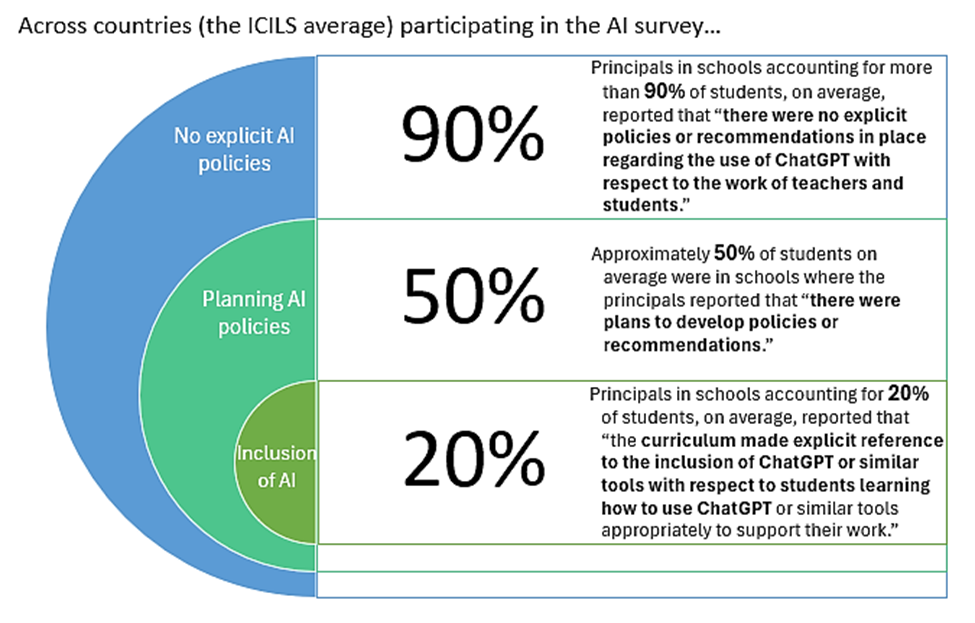
Selected data from Fraillon, J. (ed.). (2025). An International Perspective on Digital Literacy: Results from ICILS 2023 (Revised), pp. 257-258.
When we look at the information on AI in curricula reported by principals, by country, we see some variability. For example, the percentage of students in schools whose principals reported that the curriculum made explicit reference to the inclusion of ChatGPT or similar tools for student learning ranged from 6 percent in Slovak Republic and Greece to 43 percent in Norway.
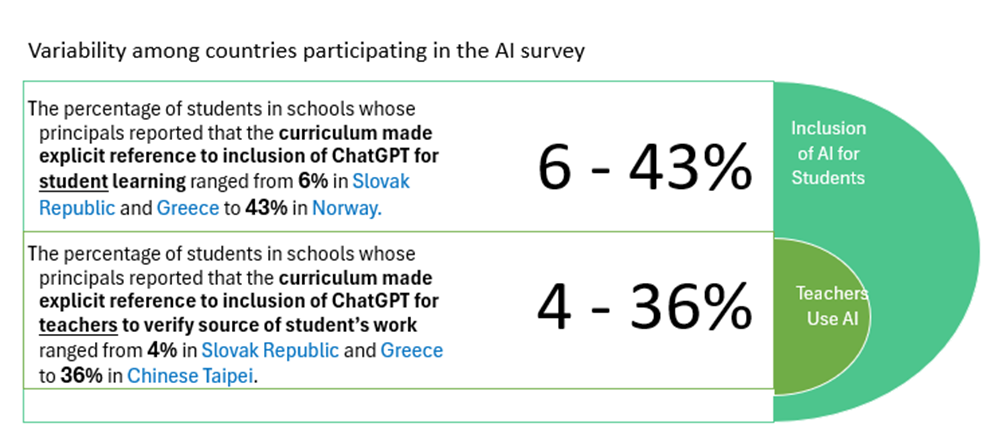
Selected data from Fraillon, J. (ed.). (2025). An International Perspective on Digital Literacy: Results from ICILS 2023 (Revised), p. 259
In 2023, how often did school leaders use AI for work purposes?
The ICILS report stated that, on average, principals in schools accounting for 9 percent of students reported using AI weekly for work purposes and “principals in schools accounting for 41 percent of students reported that they use these tools less than weekly.” 10 Additionally, “principals in schools accounting for 50 percent of students reported that they never use ChatGPT or similar tools for work‐related purposes.”11
Findings from the special survey suggested that, at least among participating countries, AI familiarity in the school context may have been limited in 2023. By 2028, ICILS will undoubtedly be better positioned to capture baseline information about AI literacy as the adoption of AI in school curricula increases, and more countries implement education policies to train teachers and students in the use of generative AI.

Photo by Max Fischer
School leaders weigh the benefits and risks of AI
The ICILS 2023 findings from the AI survey reflected school leaders’ recognition of increased AI adoption to advance student learning and at the same time concerns about AI misuse. Many students were in schools where their principals could see both the benefits and risks of using generative AI in teaching and learning.12 The risks included concern that the use of generative AI was likely to encourage students to submit work that was not their own and likely to confuse students with false, misleading, or biased information. The benefits included the notion that the use of AI would likely make it easier for teachers to create learning resources for students and that AI could enhance individualized student learning. Conclusions from a 2025 report on AI in education commissioned by Microsoft reflected a similar sentiment among school leaders; they anticipated increased use of AI and at the same time expressed concerns about privacy, piracy, security, and overdependency of information gleaned by AI.13
Based on image by Mohamed Hasan
School leaders expect AI usage to increase at school
Forecasts from industry and governments predicted an increase in the use of AI in school as did a majority of international K-12 leaders and teachers that participated in the 2025 Microsoft study. Roughly 85 percent of principals and 77 percent of teachers reported that they expected AI usage to increase in their school districts.14 Aiding this effort, several large technology companies have offered free access to AI training tools to teachers and students in the U.S. and abroad.15,16 As expressed in a Microsoft AI report, “AI fluency is a workforce imperative with growing pressure on institutions to prepare students accordingly.”17
Given the focused efforts to prepare students and teachers for using AI, I look forward to the release of the ICILS 2028 results that will address the question of how 8th grade students are progressing in digital literacy overall, establish baseline information on AI literacy, examine student understanding of responsible and ethical use of AI, and report on the international education landscape as it relates to current technology’s role in teaching and learning.
- Generative Artificial Intelligence may be defined as a technology that can create original text, images, video, and other content. It is a form of deep machine learning that aims to simulate the decision-making complexity of the human brain using a neural network framework.
Office of Educational Technology. (2023) Artificial Intelligence and the Future of Teaching and Learning. pp. 1, 11-13. files.eric.ed.gov/fulltext/ED631097.pdf ↩︎ - Mucci, T. (n.d.). The history of artificial intelligence. https://www.ibm.com/think/topics/history-of-artificial-intelligence ↩︎
- Timeline of artificial intelligence. (n.d.). In Wikipedia. https://en.wikipedia.org/wiki/Timeline_of_artificial_intelligence ↩︎
- Computer and Information Literacy (CIL) is defined as “an individual’s ability to use computers to investigate, create, and communicate in order to participate effectively at home, at school, in the workplace, and in society.” Computational Thinking (CT) is defined as “an individual’s ability to recognize aspects of real-world problems which are appropriate for computational formulation and to evaluate and develop algorithmic solutions to those problems so that the solutions could be operationalized with a computer.” In Fraillon, J., Ainley, J., Schulz, W., Friedman, T., & Duckworth, D. (2019). Preparing for Life in a Digital Age:IEA International Computer and Information Literacy Study 2018 International Report, pp. 17 and 27. https://www.iea.nl/publications/study-reports/international-reports-iea-studies/preparing-life-digital-world ↩︎
- An education construct can be thought of as an abstract idea that is developed to explain a particular aspect of an educational phenomenon, and then operationalized in order to be made measurable in terms of behavior, affect, or intellectual engagement. Teachers.Institute. (2023). Rethinking Concepts and Constructs in Education Research. https://teachers.institute/educational-research/rethinking-educational-concepts-constructs/ ↩︎
- IEA. (n.d.). AI in ICILS 2028, pp. 4-5. https://online.flippingbook.com/view/845045247/ ↩︎
- Ibid. ↩︎
- Fraillon, J. (ed.). (2025). An International Perspective on Digital Literacy: Results from ICILS 2023 (Revised). pp. 255-272. Retrieved on Dec 22, 2025 from https://www.iea.nl/publications/icils-2023-international-report. Also located at Fraillon, J. (2025). Principals’ Reports on the Use of Generative AI Tools in Schools: ICILS 2023 International Option. In: Fraillon, J. (eds) An International Perspective on Digital Literacy. Springer, Cham. https://doi.org/10.1007/978-3-031-87722-3_9 ↩︎
- The twelve education systems participating in the ICILS 2023 AI-usage survey were Chile, Chinese Taipei, Cyprus, Denmark, Greece, Korea (Rep. of), Norway, Romania, the Slovak Republic, Slovenia, Sweden, and Uruguay. ↩︎
- Fraillon, J. (ed.). (2025). An International Perspective on Digital Literacy: Results from ICILS 2023 (Revised), pp. 256 and Appendix I on p. 379. Changes to font type made by author of this blog. https://www.iea.nl/publications/icils-2023-international-report ↩︎
- Ibid. ↩︎
- IEA. (n.d.). AI in ICILS 2028, pp. 2-3. ↩︎
- Microsoft.(2025, June 23). 2025 AI in Education: A Microsoft Special Report, p. 18.https://cdn-dynmedia-1.microsoft.com/is/content/microsoftcorp/microsoft/bade/documents/products-and-services/en-us/education/2025-Microsoft-AI-in-Education-Report.pdf ↩︎
- Microsoft. (n.d.). 2025 AI in Education Report Survey Details: Microsoft Education, p. 47. https://cdn-dynmedia-1.microsoft.com/is/content/microsoftcorp/microsoft/bade/documents/products-and-services/en-us/education/Survey-Data-2025-Microsoft-AI-in-Education-Report.pdf ↩︎
- R. Schoeder. (2025, September 3). AI Companies Roll Out Educational Tools. https://www.insidehighered.com/opinion/columns/online-trending-now/2025/09/03/ai-companies-roll-out-educational-tool ↩︎
- On December 4, 2025, KHQ.com reported that Washington (State) schools were partnering with Microsoft to integrate artificial intelligence into classrooms across the state. Microsoft agreed to provide for free its Co-Pilot tool to every student in the state and also to train 2,000 teachers to use Co-Pilot. Retrieved on Dec. 4, 2025 from https://www.khq.com/news/education-officials-propose-guidelines-ahead-of-microsoft-ai-partnership-with-washington-schools/article_e511a55c-e199-4cc2-8fc2-2a2666db08f1.html ↩︎
- Microsoft Education Team. (2025, August 20). AI in Education Report: Insights to support teaching and learning. https://www.microsoft.com/en-us/education/blog/2025/08/ai-in-education-report-insights-to-support-teaching-and-learning/ ↩︎
Leave a Reply